What is collateral management?
Collateral management is the process a bank uses to take, value, register, monitor and release the assets a borrower pledges to secure a loan. In short, its purpose is simple: if the borrower cannot repay, the bank can then recover the money the borrower owes it. Moreover, the bank can show at any time that the security still exists and, equally important, that it still holds enough value.
In practice that means keeping a single, current record of every pledged asset, what it is worth after a safety margin, which loans it secures, and when anything about it expires. A bank that cannot answer those four questions quickly does not really know how secured its loan book is.
Loan collateral and capital markets collateral
The term covers two different jobs, and most search results mix them up. This guide is about the first: collateral that secures loans to customers.
| Loan collateral | Capital markets collateral | |
|---|---|---|
| What it secures | Mortgages, business loans, vehicle and asset finance, overdrafts | Derivatives, repo and securities lending between institutions |
| Typical assets | Property, vehicles, equipment, deposits, receivables, guarantees | Cash and high-quality securities |
| How often it is valued | Periodically, often yearly, and on any trigger event | Daily, with margin called when values move |
| Who runs it | Credit and lending operations | Treasury and the trading desk |
| Where it lives | The core banking and lending systems | Specialist margin and treasury systems |
A retail or SME lender, a greenfield digital bank or a finance company is dealing with loan collateral. That is where the rest of this guide stays.
What are the main types of collateral?
Most loan collateral falls into five groups. Each one needs watching for something different, which is why a single record for all of them matters.
| Type | Examples | What the bank has to watch |
|---|---|---|
| Real estate | Homes, offices, warehouses, land | Valuation age, property insurance, the registered mortgage |
| Movable assets | Vehicles, machinery, equipment, inventory | Depreciation, physical condition, insurance, location |
| Financial assets | Cash deposits, securities, gold | Market value, and that a pledged deposit is blocked from withdrawal |
| Receivables | Invoices owed to the borrower by its customers | Ageing, concentration on a few debtors, whether they are paid |
| Guarantees and insurance | Bank, corporate and personal guarantees, credit insurance | Expiry dates, the guarantor’s own standing, claim conditions |
Islamic financing uses collateral too, under the concept of rahn (pledge). The asset types and the lifecycle are the same; what changes is the financing contract the collateral sits behind.
The collateral lifecycle
Every piece of collateral moves through the same six stages, starting on the day the borrower offers it and ending on the day the bank either releases it or sells it. Stage 5 runs for the whole life of the loan.
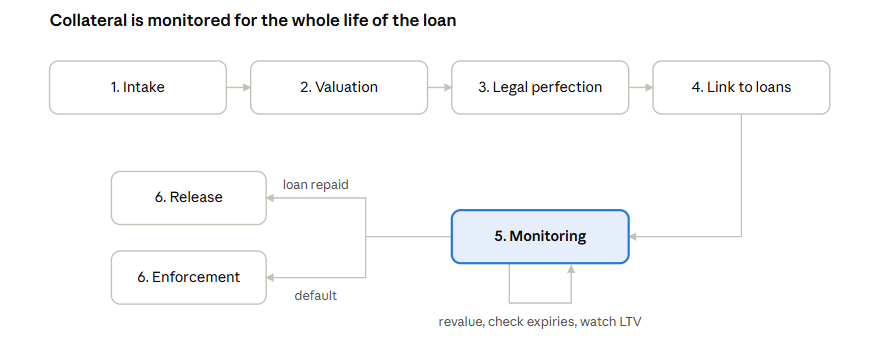
- Intake and eligibility. Record what the borrower offers and check it is acceptable under the bank’s credit policy.
- Valuation and haircut. Set a market value, then apply a haircut, a discount for the risk that the value falls or the asset is hard to sell. The result is the value the bank will lend against, and it gives the loan to value (LTV) ratio.
- Legal perfection. Register the mortgage, pledge or lien so that the claim holds up if anyone ever challenges it. After that, attach the insurance and guarantee documents as well.
- Linking to facilities. Allocate the collateral to the loans it secures. One asset can secure several loans and one loan can have several assets, so the allocation has to add up without counting anything twice.
- Monitoring. Revalue on a schedule and on trigger events, track every expiry date, and watch LTV against the limit the credit policy sets.
- Release or enforcement. Release the collateral and close its record when the loan is repaid, or enforce on it after a default.
What is a collateral management system?
A collateral management system is the software that keeps the lifecycle above in one place and connected to the loans. It replaces the spreadsheets and paper files that many banks still use, where the collateral record and the loan record drift apart.
What it typically does:
- Keeps one register of every pledged asset, with its documents, owner and legal status
- Stores each valuation with its date and source, and applies the bank’s haircuts
- Allocates collateral across facilities and calculates LTV and the secured and unsecured parts of each exposure
- Raises alerts for expiring insurance, guarantees and valuations, and for LTV breaches
- Blocks release while a loan is still outstanding, and records release when it is repaid
- Feeds collateral values to risk, provisioning and regulatory reporting
What is collateral management in banking? An example
An SME borrows USD 1,000,000, secured by a commercial property valued at USD 1,250,000. The LTV is 80 per cent, inside the bank’s policy limit of 85 per cent.
A year later the property is revalued at USD 1,100,000, so LTV rises to about 91 per cent. In the same month, the property insurance expires.
A collateral management system flags both on the day they happen. The bank can ask for more collateral or a part repayment, and chase the insurance renewal. Without one, both problems often surface only at the annual review, or after a default, when the bank finds it is less secured than its books say.
Why collateral management matters to a bank
Collateral only protects a bank if it is enforceable, valued and recorded against the right loans. Three parts of the bank depend on that.
Credit risk. Collateral reduces the loss when a borrower defaults. A pledge the bank cannot enforce, or an asset worth half its recorded value, reduces nothing.
Capital. Under the Basel standardised approach, eligible collateral can lower the capital a bank holds against an exposure. The relief comes with conditions: the documentation must be binding and legally enforceable in all relevant jurisdictions (CRE22.9), and under the simple approach financial collateral must be revalued at least every six months (CRE22.33). A bank that cannot evidence both cannot take the relief.
Provisions. Under IFRS 9, the estimate of expected credit losses has to reflect the cash flows expected from collateral that is part of the loan’s contractual terms (IFRS 9, B5.5.55). Stale collateral values feed straight into the wrong provision.
Supervisors and auditors test all three, which is why a collateral record has to be current, complete and provable, not just present.
Where banks go wrong
Most collateral problems are not fraud. They are records that stopped matching reality, and nobody was told.
- Collateral kept outside the loan system. A spreadsheet or a separate tool that lending staff update by hand drifts away from the loan book.
- Stale valuations. A property valued at origination and never again is carried at a number nobody can defend.
- Missed expiries. Insurance, guarantees and valuations lapse quietly, and the first anyone hears of it is after a loss.
- Double counting. The same asset is pledged against two loans and counted in full against both.
- Unclosed releases. Collateral released on repayment stays on file as active, overstating how secured the book is.
- No link to provisioning and reporting. Risk and finance work from a different collateral figure than lending does.
How Fimple handles collateral management
Fimple is a cloud-native core banking platform for banks, greenfield banks and fintechs. Collateral management is one of its modules, so collateral sits in the same platform as the loans it secures rather than in a separate tool.
- One record, linked to the loan. Each pledged asset is held against the facilities it secures, so lending, risk and finance read the same figure.
- Expired collateral is caught automatically. Since release v1.36, the platform flags collateral that has expired, instead of leaving it to a manual review. See the v1.36 release notes.
- Open to the bank’s other systems. With more than 11,000 APIs, collateral data can flow to valuation providers, registries and reporting tools.
To see how it works with your own loan products, request a demo, or read more about collateral management in Fimple.
Frequently asked questions
What is loan to value (LTV)?
LTV is the loan amount divided by the value of the collateral securing it. A USD 800,000 loan against a USD 1,000,000 property has an LTV of 80 per cent. Banks set a maximum LTV in their credit policy and watch it for the life of the loan.
What is a haircut on collateral?
A haircut is a discount applied to the market value of collateral, to allow for the value falling or the asset being slow to sell. The more volatile or less liquid the asset, the bigger the haircut.
How often should collateral be revalued?
It depends on the asset and the bank’s policy. Financial collateral is often valued daily, while property is usually revalued periodically and after events such as a market fall or a missed payment. Under the Basel simple approach, eligible financial collateral must be revalued at least every six months.
Can one asset secure more than one loan?
Yes. A property can secure a mortgage and a business loan, for example. The bank then has to allocate its value between the two so the same value is not counted twice.
What is the difference between collateral and a guarantee?
Collateral is an asset the bank can take and sell. A guarantee is a promise by a third party to pay if the borrower does not. Banks often hold both, and track a guarantee’s expiry date the same way as an insurance policy’s.
Sources
- Basel Framework, CRE22: Standardised approach, credit risk mitigation, Bank for International Settlements. Paragraphs 22.9 (legal enforceability) and 22.33 (revaluation at least every six months under the simple approach)
- IFRS 9: Credit enhancement in the measurement of expected credit losses, IFRS Foundation, on paragraph B5.5.55
- Fimple v1.36 release notes