Embedded lending is credit offered inside a non-financial company’s customer journey, at the moment the customer needs it: instalments at an online checkout, working capital inside a merchant’s dashboard, or payment terms in a B2B ordering portal. The platform distributes the offer. A licensed lender, usually a bank or finance company, provides the credit under the applicable legal arrangement, unless the platform holds a lending licence of its own.
That split is how a retailer, marketplace or software company can offer credit without becoming a bank. It is also where most of the work sits: someone has to hold the right licence, keep the loan records and carry the credit risk, while the customer journey still feels like one.
What is embedded lending?
Embedded lending is a form of embedded finance: the credit product sits inside a journey the customer is already in, rather than in a separate application with a bank. The customer applies where they buy or work, the decision arrives in the same flow, and repayments are often managed there too.
Common forms include:
- Consumer instalments at checkout, including buy now, pay later (BNPL) and longer instalment loans.
- Merchant working capital, offered by a payments or e-commerce platform and often assessed on the merchant’s sales history.
- Trade credit between businesses, with payment terms offered inside a procurement or ordering platform.
- Point-of-need personal finance inside apps for travel, education, healthcare or telecoms.
How is embedded lending different from BNPL and a traditional loan?
BNPL is one kind of embedded lending, not the whole of it. The table compares the three on typical features; actual terms vary by product and market.
| Traditional loan | BNPL | Embedded lending | |
| Where the customer applies | With the lender, in a branch, app or website | At the merchant’s checkout | Inside any partner’s journey: checkout, dashboard, ordering portal or app |
| Typical products | Personal, auto, mortgage and business loans | Short instalment plans for a purchase | BNPL, instalment loans, merchant working capital, trade credit |
| Cost to the borrower | Interest or profit, plus fees | Often none if paid on time; the merchant usually pays a fee | Depends on the product: from no cost to interest or profit |
| Data behind the decision | Application, bureau and bank data | Purchase, bureau and payment history | Partner data such as sales or order history, where permitted, plus bureau data |
| Who the customer sees | The lender | The BNPL provider and the merchant | Usually the partner’s brand, with the lender disclosed |
How can a non-bank offer credit without needing a full banking licence?
In most markets, firms need a full banking licence primarily to take deposits. They can usually lend under narrower arrangements, and most embedded lending programmes follow one of three routes.
- Partner with a licensed lender. The platform distributes the offer and runs the customer journey. A bank or finance company approves the application, funds the loan and holds it on its books. Depending on the market, the platform may act as an agent or introducer and may need the regulator’s approval for that role.
- Get a non-bank lending licence. Some platforms obtain a finance company, consumer finance or BNPL licence. credit decisions. Each regulator defines the scope of these licences, which are narrower than a bank licence and suit platforms that want to make their own credit decisions.
- Share the risk with a lender. The licensed lender remains the lender of record, but the arrangement shares part of the credit risk with the platform, or moves loans to other funders under contract. These terms are contractual and need to be acceptable to the regulator.
None of these routes is right in every case. The choice depends on the product, the volumes, how much control the platform wants over credit decisions and what the regulator in each market allows.
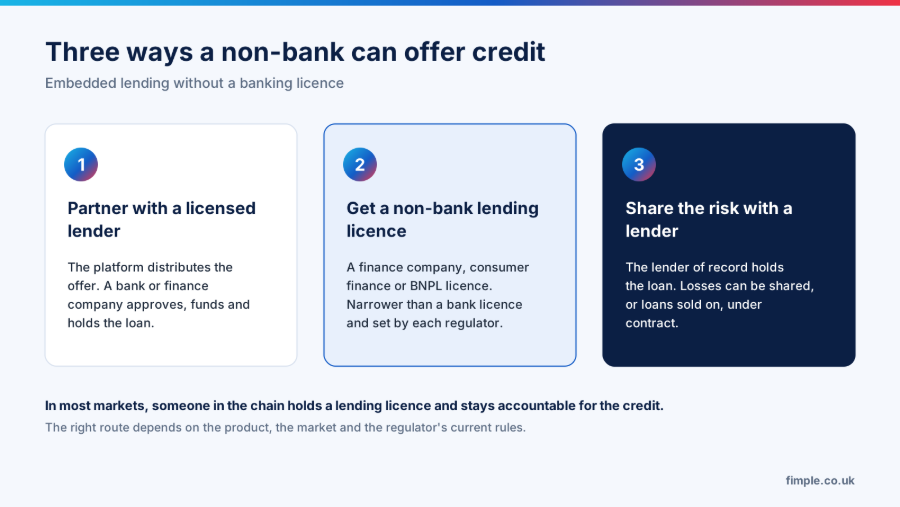
Three routes to embedded lending without a banking licence
Who carries the risk in embedded lending?
Each party carries a different part. Contracts, licences and jurisdiction determine how the parties divide responsibilities.
| Party | What it typically carries |
| The platform or distributor | The customer journey, clear disclosures in its own channels, its own data protection duties and, under some arrangements, a share of credit losses |
| The licensed lender | The credit decision, affordability and responsible lending rules, KYC and anti-money laundering controls, complaints, collections conduct and regulatory reporting |
| Funding partners | The economic exposure on loans they fund or buy, under the terms of the agreement |
| The technology provider | Running the systems that originate, service and record the loans, under the lender’s oversight |
Records are a common weak point in partner models. The responsible lender needs complete, timely and auditable customer-level records, and a clear owner for reconciliation with each partner. Our comparison of embedded finance and Banking as a Service shows what happened in the United States when partner banks relied on an intermediary’s books.
What are the rules for embedded lending in the GCC, Egypt and the UK?
Most markets regulate who may lend to consumers and on what terms, and several now have rules written specifically for BNPL and short-term credit. A summary of the current position:
| Market | Current rules | What it means for a platform |
| Saudi Arabia | SAMA issued the Rules for Regulating Buy Now Pay Later Companies on 17 December 2023. They cover licensing, consumer protection, information security and financial crime controls for BNPL companies | Offering BNPL in the Kingdom needs a SAMA licence, held by the platform or by a licensed partner. Other consumer credit goes through licensed banks or finance companies |
| UAE | The CBUAE brought BNPL and other short-term credit under its amended Finance Companies Regulation on 27 December 2023 | Short-term credit can be offered by licensed banks and finance companies, by entities acting as their agents with CBUAE approval, or by entities licensed as Restricted Licence Finance Companies |
| Egypt | Consumer finance is supervised by the Financial Regulatory Authority under Law No. 18 of 2020. FRA Resolution No. 43 of 2026, issued in February, suspended new applications for fintech-based consumer finance licences for one year | While the suspension runs, a new platform cannot apply for a fintech-based consumer finance licence, so partnering with a company that is already licensed is the usual starting point |
| United Kingdom | Since 15 July 2026, interest-free deferred payment credit (BNPL) offered by third-party lenders is regulated by the FCA under Policy Statement PS26/1 | Lenders need FCA permission; firms without consumer credit permissions had to register for the Temporary Permissions Regime from 15 May 2026. The rules cover clear information, sustainable and affordable borrowing, and support for customers in difficulty. Merchants offering their own deferred payment credit directly are outside the scope |
Limits, caps and licence categories change by circular and resolution. Check the regulator’s current version before designing a product, not a summary written months earlier, including this one.
What does a lender need to run embedded lending at scale?
Embedded lending moves the customer journey to the partner, but the lender’s systems still do the lending. A bank or finance company serving several partners needs:
- Products configured per partner. Each programme has its own product, pricing, tenors, limits and eligibility, set as parameters rather than built as code for each new partner.
- Decisions through APIs, in the partner’s flow. Application, scoring and limit checks return inside the checkout or dashboard, so the customer is not sent elsewhere.
- Scoring that can use partner data. Sales, order or payment history from the partner, where the customer has agreed and the rules allow, alongside bureau data.
- One view of each customer’s exposure. The same customer may borrow through several partners, and limits should reflect all of it.
- Disbursement and settlement. Paying the merchant or the customer, collecting repayments and reconciling both sides with each partner.
- The full loan lifecycle. Repayment schedules, reminders and collections, then post-loan management: rescheduling, refinancing, early payoff and closure.
- Records and reporting the lender owns. Customer-level records, separate reporting per partner programme and the regulatory reports each market requires.
- Islamic structures where needed. Where instalments are offered on a Sharia-compliant basis, for example through Murabaha, the core has to support the structure natively rather than as a relabelled loan.
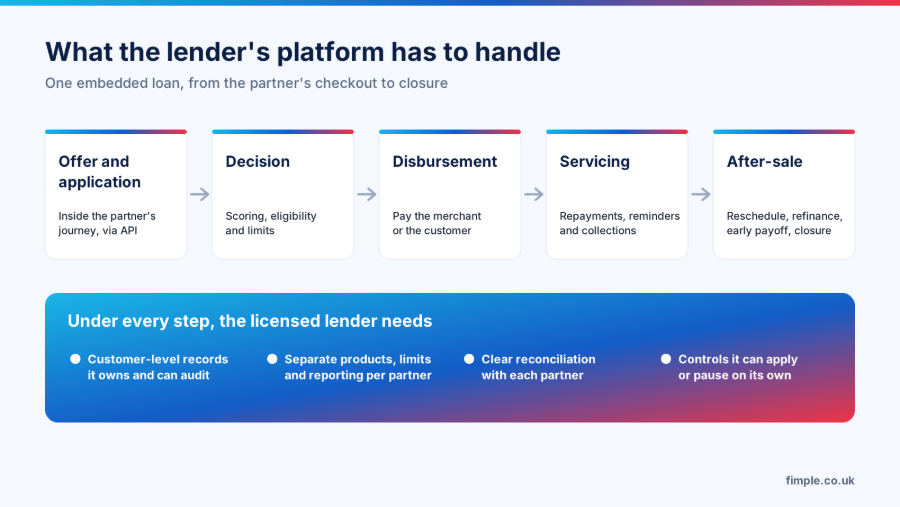
What the lender’s platform has to handle, from checkout to closure
How Fimple fits
Fimple supplies the lending technology behind embedded programmes, through an API-first, composable technology platform. Fimple’s digital lending platform runs on Fimple’s core banking platform and supports microloans, personal loans, mortgages, business loans and buy now, pay later, each with its own terms, rates and repayment schedules. Open APIs connect it to partner channels, from initiation to repayment, and it can also integrate with a core banking system an institution already runs.
Credit scoring, limit management and collateral management are modules of the same platform, and loan after-sale services cover rescheduling, refinancing, early payoff and closure. Conventional and Islamic products can run on one platform.
Fimple’s role is to supply technology, not to replace the licensed lender. Credit decisions, regulated activity, customer protection and regulatory accountability stay with the institution under the applicable arrangements.
Frequently asked questions
Do you need a banking licence to offer embedded lending?
Usually not. Most platforms either partner with a licensed bank or finance company, or obtain a narrower lending licence such as a finance company or BNPL licence. What is required depends on the country, the product and the platform’s own role, so check the regulator’s current rules before launch.
Is BNPL the same as embedded lending?
BNPL is one form of embedded lending. Embedded lending also includes instalment loans that charge borrowers, working capital for merchants, and trade credit between businesses whenever companies integrate credit offers into their own customer journeys.
Who carries the credit risk in embedded lending?
Normally the licensed lender that holds the loan. Some arrangements share losses with the platform or move loans to other funders under contract, but the lender of record usually stays accountable to the regulator and the customer.
What is an example of embedded lending?
An online retailer offering instalments at checkout, a payments provider offering working capital to merchants based on their card sales, or a B2B ordering portal offering 60-day terms to buyers. In each case, a licensed lender, or the platform under its own lending licence, provides the credit.
Planning a lending programme with partners? See how Fimple’s lending technology can support your products, partners and integration requirements.