Islamic lending is growing quickly, and more banks now want to offer it next to their conventional loans. However, the two models work in very different ways. A conventional loan earns interest on money, while Islamic lending earns a return through trade, leasing or partnership. As a result, many banks end up running two separate systems, with two sets of data, reports and processes.
This guide explains what really differs between Islamic and conventional lending, which contracts a bank must support, and how profit, rebates and late payments work. It also shows why one loan management system can run both side by side.
How Islamic lending differs from conventional lending
In a conventional loan, the bank lends money and charges interest on it. The customer owns the asset from day one, and interest keeps adding to what they owe.
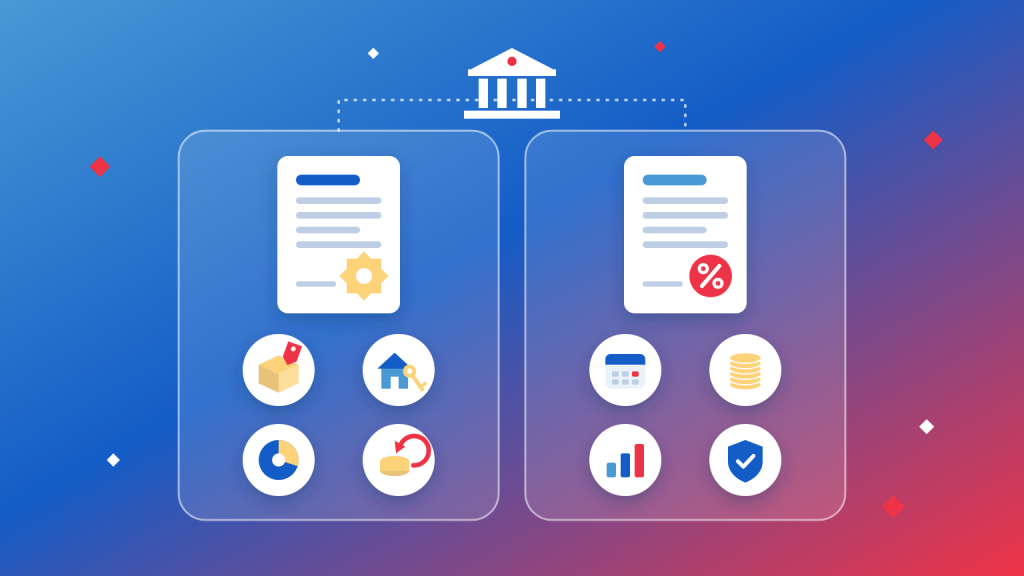
Islamic lending follows a different principle. Because Sharia prohibits riba, or interest, the bank cannot earn money simply by lending money. Instead, it earns a return by taking part in a real transaction. For example, it buys an asset and sells it at a profit, leases it for rent, or invests alongside the customer and shares the profit.
This difference shapes everything a lending system does. First, the bank often owns the asset for a period, so the system must record that ownership. Second, both sides agree the price or the profit share upfront, so the system cannot simply add interest when a payment is late. Finally, each product needs approval from the bank’s Sharia board, so every step must leave a clear audit trail.
The Islamic financing contracts a loan management system must support
Most Islamic banks build their lending on four contracts. Each one has its own structure, so a system must model each contract properly rather than relabel a conventional loan.
Murabaha, a cost-plus sale. The bank buys the asset the customer needs, such as a car or equipment, and then sells it to the customer at cost plus a disclosed profit. The customer then pays the agreed price in fixed instalments. Our guide to Murabaha walks through each step.
Ijara, a lease. The bank buys the asset and leases it to the customer for an agreed rent. In Ijara muntahia bittamleek, ownership also passes to the customer at the end of the lease.
Mudaraba, an investment partnership. The bank provides the capital, and the customer runs the business. They share the profit by an agreed ratio. However, the bank bears any financial loss, unless the customer acted negligently.
Musharaka, a joint partnership. The bank and the customer both contribute capital and share the profit by an agreed ratio. In diminishing Musharaka, which banks often use for home finance, the customer buys the bank’s share step by step until they own the asset outright.
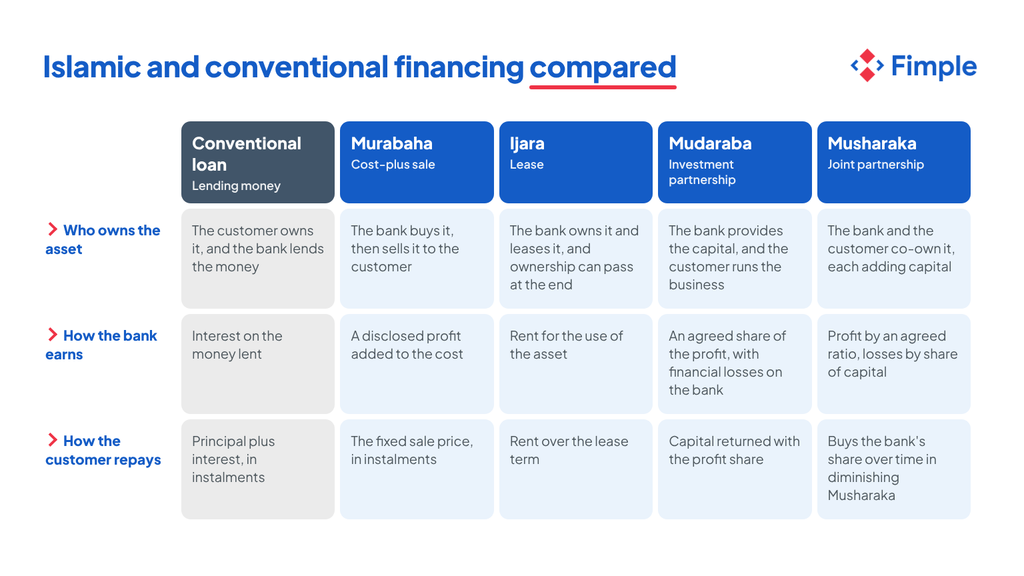
In short, conventional lending moves money, while Islamic lending moves assets or shares in a business. A loan management system therefore needs its own product logic for each contract, not one template with a new name.
Profit, rebates and late payments in Islamic finance
Profit. In Murabaha, the bank fixes its profit when it agrees the sale. It cannot raise the price later, even if market rates rise. As a result, the system must lock the sale price and spread the profit across the term, instead of recalculating interest every month. On the accounting side, AAOIFI’s FAS 28, Murabaha and Other Deferred Payment Sales, sets out how Islamic financial institutions account for these sales.
Rebates. When a customer pays off early, the bank may give back part of the profit it has not yet earned. This rebate is known as ibra. Depending on local rules, the bank either grants it at its own discretion or must grant it. Therefore, the system must calculate the unearned profit and apply the right rebate policy for each product.
Late payments. In a conventional loan, a late payment usually adds interest. In Islamic lending, however, the debt does not grow. Instead, many banks apply a late payment charge that goes to charity rather than to the bank’s income. The system must route those charges to a separate account and keep them out of profit.
Why one platform works better than two separate systems
Many banks start Islamic lending on a separate system, often because their conventional core cannot handle the contracts. Over time, though, two systems create real problems:
- Two customer records. A customer with a conventional account and an Islamic financing appears twice, so the bank never sees one view of them.
- A split view of risk. Limits and exposure sit in two places, which makes group-level risk harder to track.
- Double the change effort. Every new regulation, report or integration needs building twice.
- Slower launches. New products wait for two release cycles instead of one.
By contrast, one platform keeps every customer, limit and report in one place. Islamic and conventional products then share the same customer record, limit checks and reporting, while each contract keeps its own rules. In other words, the bank adds Islamic lending as a set of products, not as a second bank.
How Fimple supports Islamic and conventional lending
Fimple serves Islamic and conventional institutions through two dedicated offerings, each with its own products and services. Rather than stretching one model to fit the other, we build each offering around the way that model actually works.
- Islamic banking. Our Islamic lending software is built around Sharia principles. It covers Murabaha, Ijara, Mudaraba and Musharaka, alongside Sukuk and Takaful, so every contract follows its own structure, from asset ownership and profit to rebates at payoff.
- Conventional banking. Our conventional lending products are built for interest-based lending, from loan setup and pricing to repayment and collections.
Because our teams work with both models every day, they know exactly where Islamic and conventional lending differ, and how to reflect those differences in each product. For example, an Ijara financing tracks the bank’s ownership of the leased asset, while a conventional loan tracks interest on the money lent. Similarly, profit, rebates and late payment charges follow the rules of each Islamic contract, not conventional interest logic.
As a result, each institution gets a platform that fits its model precisely, whether it offers Islamic lending, conventional lending or both. Today, Fimple serves 35+ customers, including banks and non-bank financial institutions. To see how it could work for your products, request a demo.
Frequently asked questions
What is the difference between an Islamic loan and a conventional loan?
A conventional loan earns interest on the money the bank lends. Islamic financing, by contrast, earns a return through a real trade, lease or partnership, and both sides agree the price or profit share upfront. As a result, the debt does not grow when a payment is late.
Can one core banking system run Islamic and conventional products?
Yes, as long as the system models each Islamic contract on its own terms. With the right platform, both share one customer record, one set of limits and one reporting layer, while each product keeps its own rules.
What is Murabaha financing?
Murabaha is a cost-plus sale. The bank buys an asset and sells it to the customer at a disclosed profit, and the customer then pays the price in instalments.
How does an early payoff rebate work in Islamic finance?
When a customer settles early, the bank may give back part of the profit it has not yet earned. This rebate is known as ibra. Depending on local rules, it is either at the bank’s discretion or required, so the system must apply the right policy for each product.
Talk to our team. See how collateral, limits and loan servicing work together on one platform, with your own loan products.