A loan management system is the software a bank uses to run every loan, from the first application to the final payment. On a core banking platform, it shares one set of customer, limit, collateral and accounting data. That way, every stage of the loan lifecycle works from the same numbers.
This guide walks through the seven stages of the loan life cycle and what the system does at each one. If you are assessing a platform for your bank, see Fimple’s loan management and after-sale services.
What is a loan management system?
A loan management system (LMS) automates the work of originating, approving, disbursing, servicing and closing loans. It calculates interest and fees and builds repayment schedules. It also tracks limits and collateral, posts entries to accounting and manages arrears.
Loan management is not one task but a chain of them. A decision made at origination, such as the limit or the collateral taken, shapes every stage that follows. That is why loan lifecycle management works best when each stage can see what the others know.
Some banks run lending on a standalone system connected to the core through interfaces. Others run it inside the core banking platform itself. When lending runs inside the core, a change in one place, such as a new collateral valuation, shows up wherever that data is used.
Why loan management is more than a single transaction
Lending is one of the most complex workflows in banking. A payment or a transfer is finished in seconds. A loan runs for months or years, passes through several teams and can change many times before it closes.
No two banks run that workflow the same way. Each bank sets its own approval steps, business rules, scoring criteria and collateral requirements, and adjusts them as its products, risk appetite and regulation change. A loan management system has to follow the bank’s rules, not force the bank into a fixed process.
That takes two things underneath. The first is a configurable product engine, where each product’s rates, fees, repayment structure and rules are defined once and applied to every loan. The second is a strong calculation engine that gets interest, instalments, fees and schedules right every time a loan is opened, changed or closed.
In Fimple, loan products are defined in a product engine with its own calculation engine and rule engine, so each bank can set up its products around its own rules.
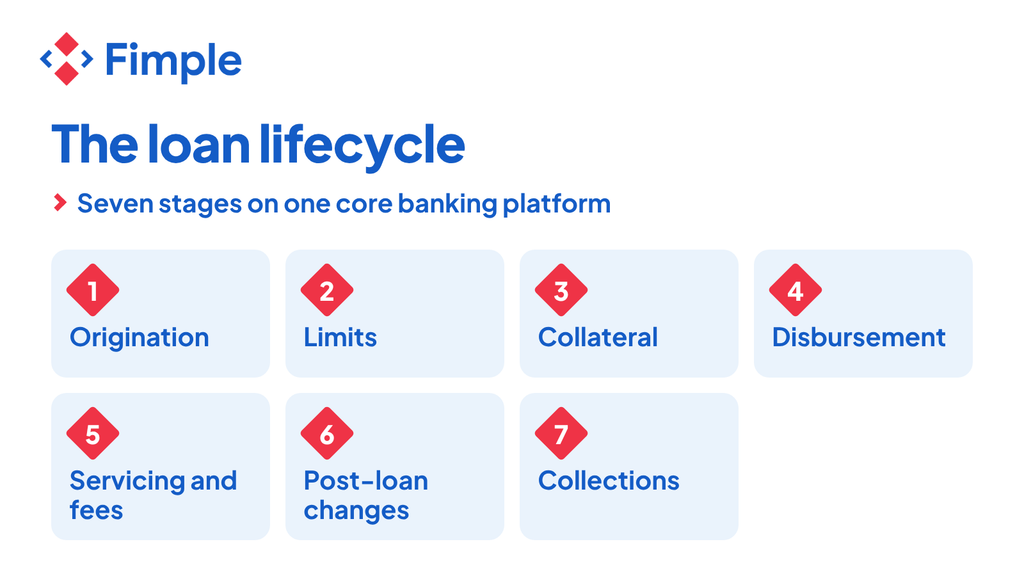
The seven stages of the loan lifecycle
Every loan passes through the same seven stages, whether it is a personal loan, a mortgage or a corporate facility.
- Origination. The application, credit assessment and approval.
- Limits. The credit line the loan draws on, and how much of it is used.
- Collateral. The assets that secure the loan, and what they are worth today.
- Disbursement. Releasing the funds once every condition is met.
- Servicing and fees. Repayments, interest and charges over the life of the loan.
- Post-loan changes. Rescheduling, refinancing, early payoff and closure.
- Collections. Recovering arrears when repayments stop.
1. Origination
Origination turns an application into an approved loan. The loan management system captures the customer’s details and checks them against the bank’s records. It then supports the credit decision.
For retail lending, that decision usually rests on a credit score from a credit bureau or an external scoring provider. For corporate lending, analysts also look at the company’s financial statements and its risk profile, which Fimple’s Financial Analysis module supports.
The product the customer applies for is defined once, in the platform’s product engine. Its rates, fees and repayment rules then apply automatically to every loan opened on it. The same applies to Islamic financing products such as Murabaha, Ijara, Mudaraba and Musharaka, which Fimple supports alongside conventional lending. You can read more on the Islamic banking page.
2. Limits
A limit is the maximum the bank is willing to lend to a customer, a group of related companies, a product or a single facility. Each new loan draws on that limit, so the system has to check what is still available before approval.
Fimple’s limit management sets limits at customer, group, product and facility level, and monitors how much of each is used in real time. It sends alerts for breaches and renewals, and it schedules periodic limit reviews.
3. Collateral
Collateral is what protects the bank if the borrower cannot pay. The loan management system registers each asset, such as property, vehicles or securities, and links it to the loans it secures.
Collateral loses value quietly. If a property securing a loan is revalued lower, the loan to value (LTV) ratio rises even though nobody borrowed more. If the insurance on that property expires, the bank’s protection weakens again.
In Fimple, collateral management is a module of the core banking platform. Each pledged asset is held against the facilities it secures, so lending, risk and finance read the same figure, and expired collateral is flagged automatically instead of being left to a manual review. For valuations, haircuts and monitoring in more depth, read our guide to collateral management in banking.
4. Disbursement
Disbursement releases the approved funds, either to the customer’s account or to a third party such as a seller. Before money moves, the system confirms that the approval is in place, that the limit has room and that the conditions attached to the loan have been met.
On a core banking platform, disbursement posts directly to the customer’s account and the general ledger. The repayment schedule starts from the same moment, so there is nothing to reconcile between systems.
5. Servicing and fees
Servicing covers the longest part of the loan lifecycle. The system accrues interest, collects instalments on their due dates and keeps the repayment schedule up to date.
Fees and charges need the same discipline. Fimple’s fees and charges management lets the bank define each fee and set the rules for when it applies. It then automates the charge and reports on it.
6. Post-loan changes
Loans rarely run exactly as first agreed. A borrower in temporary difficulty may need new repayment terms. Another may want to refinance or consolidate several loans, or to pay off early.
Fimple’s loan management and after-sale services cover these changes. They include rescheduling, refinancing, early payoff and loan closure, as well as lease closure for leasing products. Each change recalculates the balance, interest and schedule automatically.
7. Collections
When repayments stop, collections begins. The system identifies overdue loans and contacts the borrower, then routes each case to the right team based on how far behind it is.
Fimple’s collection management uses automated workflows and proactive notifications to reduce delinquency, with compliance-ready processes built in.
Why the loan lifecycle works better on one platform
Each stage of the loan lifecycle depends on data from the others. Approval needs the limit, and the limit needs current collateral values. Servicing needs the fee rules, and collections needs the repayment history. When those pieces sit in separate systems, teams spend time reconciling them, and risk shows up late.
Running loan management inside the core banking platform gives the bank three practical gains.
- One view of exposure. Limits, collateral and outstanding balances come from the same data, so credit teams see real exposure, not an estimate.
- Fewer handoffs. Disbursement, servicing and accounting post in one place, which cuts manual reconciliation.
- Change at your own pace. With a modular platform, a bank can modernise one part of lending at a time without replacing everything at once.
Frequently asked questions
What is the difference between loan management and loan origination?
Loan origination covers the first stage only: the application, credit assessment and approval. Loan management covers the whole loan lifecycle, from origination through servicing, post-loan changes and collections.
What are the stages of the loan lifecycle?
The loan lifecycle has seven stages: origination, limits, collateral, disbursement, servicing and fees, post-loan changes, and collections. Every loan moves through them in that order, although post-loan changes and collections only apply to some loans.
What is loan lifecycle management?
Loan lifecycle management means running every stage of a loan in one connected process. Data captured at origination, such as limits and collateral, stays available and up to date until the loan closes.
Why is loan management so complex?
Because every bank runs lending its own way. Approval steps, business rules, scoring criteria and collateral requirements differ from bank to bank and change over time. The system needs a configurable product engine and a strong calculation engine to follow those rules for every loan.
Can one loan management system handle Islamic and conventional loans?
Yes, if the platform supports both product types. Fimple supports conventional lending alongside Islamic financing products such as Murabaha, Ijara, Mudaraba and Musharaka.
How does a loan management system track collateral?
It registers each asset and links it to the loans it secures. It also tracks valuations over time. It then alerts the bank when a value drops or a key date, such as an insurance or valuation expiry, passes.
Run the whole loan lifecycle on one platform
Fimple brings origination, limits, collateral, servicing, post-loan changes and collections onto one composable core banking platform. See how it works on our loan management and after-sale services page.
Which stage of the loan lifecycle causes your team the most manual work today?